
Every PCS resets a military child’s routine: a new school, new friends and, often, a waitlist for the team or class they loved. Chess is one of the few activities that can come along unchanged. Here is how to keep it going through moves and deployments.
Why hobbies get lost in a move
A typical military-connected student, mostly in active-duty families, moves about six to nine times between kindergarten and high school graduation, according to research for the Military Child Education Coalition. Each move tests the things a child does outside school. Sports have seasons and tryouts, music teachers and clubs have waitlists, and a family that arrives in March may wait until fall to start again. Every restart costs momentum, and some kids simply stop.
Chess holds up better than most. It does not need a field, a team or a season, and almost everything a child has learned comes along in their head and on their phone.
What makes chess portable
- It fits in a suitcase. A roll-up board and a bag of pieces weigh less than a pair of sneakers. Pack them in the luggage that travels with you, not in the household goods shipment that may take weeks to arrive.
- Progress travels too. An online rating, saved games and solved puzzles stay with your child’s account, not at the old duty station.
- It works across time zones. Many online games allow a day or more per move, so a player in Germany and a player in Texas can keep the same game going.
- It is a shared language. Whether the new school is a DoDEA school overseas or a civilian district stateside, a child who plays chess can usually find someone to play: at a school club, at the library, or online while they settle in.
Keep the same coach through the move
If your child takes chess lessons, the biggest loss in a PCS is usually the teacher who knew them: what they have learned, where they get stuck and how to keep them motivated. Online lessons remove that problem. The class meets on video, so the coach and the group can stay the same whether your next orders take you across the state or across the country.
A few questions to ask before you sign up:
- How are lesson times shown, and what happens when you change time zones? A good school shows the schedule in your local time and helps you find a new slot after a move.
- How big are the groups? In a small group the coach sees every child’s moves and mistakes.
- How are children kept safe? Look for background-checked coaches and private lesson rooms that only enrolled children can join.
- Can you try a lesson first? A trial tells you quickly whether the time slot and the coach work for your family.
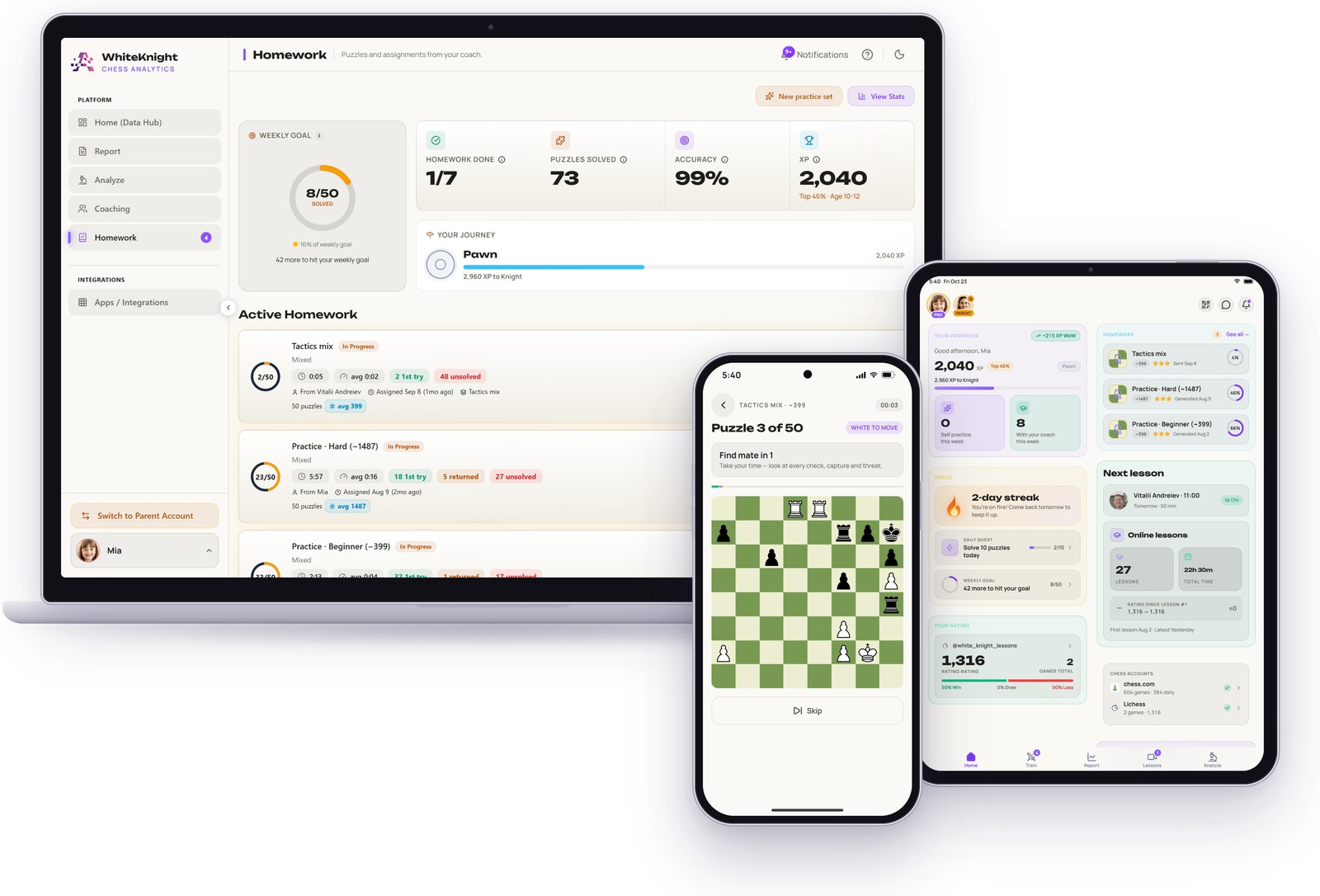
WhiteKnight Academy, for example, teaches live weekly lessons online in groups of up to five children aged 6 to 14, shows each family the lesson times in its own time zone, and makes the first lesson free and one-to-one. If you are heading overseas, check the schedule against your new time zone before you commit: a class that fits after school in Texas can fall late at night in Germany or early in the morning in Japan.
Playing chess with a deployed parent
Chess is also one of the easiest ways for a child to share something with a parent who is deployed. Both Chess.com, with its “Daily” games, and Lichess, with its “Correspondence” games, let each player take a day or more per move. One long game can run for weeks, and the moves become something to talk about on the next call.
A few ideas that work well:
- Start one game before the deployment and agree to finish it at homecoming.
- Go over the latest moves together on a video call.
- Let your child “coach” the parent through a puzzle, which turns the usual roles around.
Online games are still online, so apply the same operations security habits as everywhere else. Military OneSource’s guidance for families is a good baseline: set accounts to private, turn off location tagging, and help children understand what is OK to share. For chess, that means usernames without real names, ranks, units or locations, and no chat about schedules or where a parent is. On Lichess, Kid mode turns off chat and messages for a child’s account, and ChessKid is Chess.com’s separate site built for children.
Getting started on a small budget
You don’t need to spend much to start. Lichess is free, with no ads. ChessKid and Chess.com both offer free accounts. A basic roll-up board costs little, and many schools and public libraries run chess clubs, so it is worth asking in the first week at a new school. Paid lessons make sense once your child wants structure and regular feedback from a coach.
A five-minute PCS checklist for your young chess player
- Write down usernames and passwords before the move.
- Pack the board in your suitcase, not with the household goods.
- If your child takes lessons, tell the coach your moving dates and new time zone early.
- Ask the new school about a chess club in the first week.
- Before a deployment, start a correspondence game together.
A move changes almost everything for a military child. A chess game that picks up exactly where it left off, with the same board, the same rating and sometimes the same coach, is one small thing that doesn’t.