
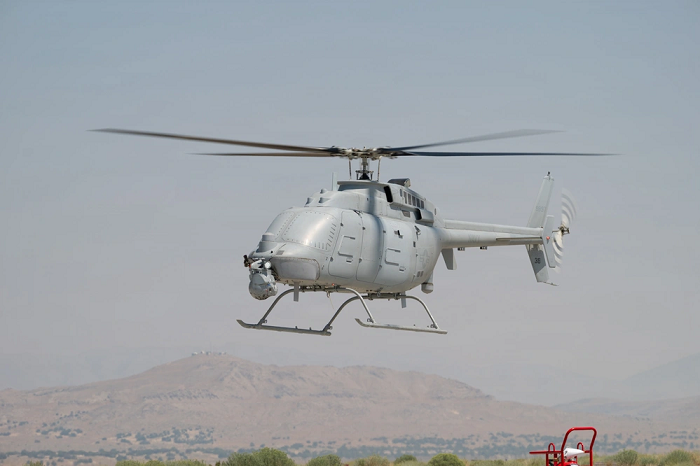
OCTOBER 23, 2026 – In a prime demonstration of Joint Force agility and resource optimization, the Navy and Army partnered to rapidly repurpose divested MQ-8C Fire Scout unmanned helicopters, transforming excess inventory into dynamic test assets.
At the direction of the Office of the Chief of Naval Operations (OPNAV N98), the Navy began divesting the MQ-8C Fire Scout platform in February 2024, with a final sundown scheduled by the end of fiscal year 2026. However, a rapid collaborative initiative has given these advanced systems a second life to accelerate critical testing for the U.S. Army.
The Multi-Mission Tactical UAS Program Office (PMA-266) was roughly 60% complete with the overall divestment process of transferring aircraft, mobile control systems and support equipment to the 309th Aerospace Maintenance and Regeneration Group (AMARG) in Tucson, Arizona, when a request for information arrived from the U.S. Army to discuss a potential handover of the assets.
In November 2024, PMA-266 received a request to evaluate whether the MQ-8C Fire Scout, which was nearing its sundown, could serve as a captive carry testbed for the U.S. Army Redstone Test Center (RTC), a subordinate organization under the U.S. Army Test and Evaluation Command (ATEC) at Redstone Arsenal, Alabama, for testing of Army sensor packages.
By December, cooperating teams scheduled a site visit to Point Mugu, California, to evaluate the MQ-8C and its mission control systems.
In January 2025, RTC submitted a formal request to Air Warfare Division of OPNAV N98 for four MQ-8C aircraft, two Mobile Mission Control Systems (MMCSs), spare engines and associated support equipment for site standup at Redstone Arsenal.
OPNAV N98 approved RTC’s request in May 2025. By July, all four aircraft, both MMCSs and dual site support equipment were successfully delivered to Redstone Arsenal to facilitate RTC’s operational plans.
PMA-266 also collaborated with Naval Supply Systems Command (NAVSUP) Weapon Systems Support (WSS) to secure vital communications security (COMSEC) assets—including radios, transponders and modems—that had already been returned to NAVSUP for common stock earlier in the MQ-8C divestment.Following a year of collaborative negotiations, the final assets arrived at Redstone Arsenal in July 2026.
“Considering where we started—having zero experience with these systems—it’s quite remarkable what has been accomplished. We are certainly thankful for the many people across various organizations that helped us along the way,” said Chief Warrant Officer 4 Taylor Kiel, test director and experimental test pilot with RTC’s Aviation Flight Test Directorate.
In August, RTC successfully completed ground testing, launching flight tests at Dugway Proving Ground, Utah, and at Redstone Arsenal to build aircrew confidence and provide hands-on maintenance experience. This collaborative effort saved the U.S. Army just over $70 million in procurement costs, with additional cost savings in research, development, test and evaluation (RDT&E), flight hours, data collection, contracts, asset sourcing and manpower.
“Our priority is delivering lethal and ready capabilities to the warfighters,” said Col. Leigh Irwin, PMA-266 program manager. “Repurposing these MQ-8C assets from storage to active testing is a major acquisition win for both services, demonstrating how we can supercharge existing capabilities and increase acquisition velocity to support joint operations.” Completing this transition and initiating flight tests within 14 months stands as a testament to the rapid acquisition timeline and the resilience of the MQ-8C platform and represents a remarkable Joint achievement by PMA-266, the Navy and Army ATEC teams in support of the warfighter.
PMA-266 has cognizance over the MQ-9 Marine Air-Ground Task Force (MAGTF) Unmanned Aircraft System (UAS), Expeditionary (MUX) Family of Systems (ACAT II) program. The program office is also responsible for emerging Group 4 and 5 vertical lift platforms.
Story by Megan Wasel
Multi-Mission Tactical UAS (PMA-266)