
OCTOBER 22, 2026 — Two dozen distinguished visitors from key military and government organizations gathered at Fort Knox’s St. Vith Range Oct. 15 to witness a technological capability that is set to reshape the future of ground combat.
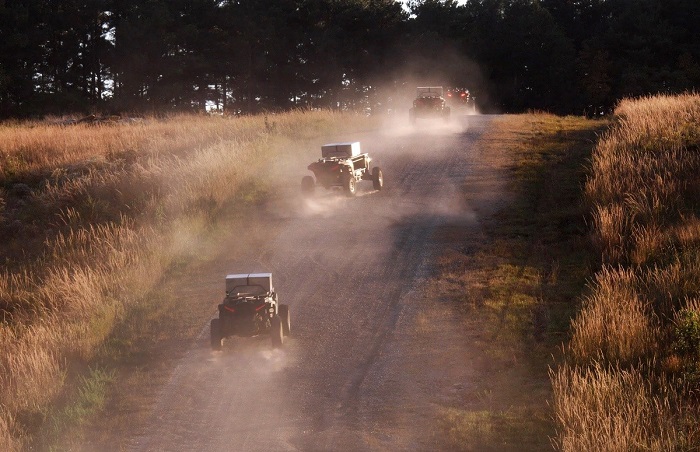
Developed under the Defense Advanced Research Projects Agency RACER program, four autonomous unmanned ground vehicles idled as technicians made final tweaks to cables and software. Once given the green light, they worked as a team, negotiating and surveilling the rolling landscape in search of enemy forces – independently operating together.
“We can drop a ten-digit grid on a traversable mobility corridor that the ground vehicles use with their onboard sensors to understand the terrain and then drive to it comparable to a human,” said Dr. Jason Gregory, technical advisor at DARPA. “Out here at Fort Knox, we’re looking at how autonomous mobility technology can be paired with payloads to enable new warfighter capabilities.”
DARPA describes itself as “an independent research and development agency within the U.S. Department of War,” which was created to ensure the United States would never be surprised by technological advancements anywhere in the world.
Robotic Autonomy in Complex Environments with Resiliency, or RACER, is one of DARPA’s 238 science and engineering programs that are working to make technological advances in national security. The RACER program focuses on combining the knowhow of three cutting-edge corporations who are working together to tackle everything from durable all-terrain vehicle designs to algorithm technologies, super intelligence and secure communications.
“We’ve completed about a five-year program on software development for autonomous mobility to go highspeed off-road in complex environments,” said Gregory. “So, now we can take a vehicle that has a sensor suite and drive-by-wire and equip it with autonomy software so it can be tasked by a Soldier as opposed to manually driven.”
Two key words describe the program’s goals in broad terms, according to the DARPA RACER website: speed and resiliency. “At a minimum, the program goal is software performance to move off-road at speeds on par with a human driver.”
Gregory said the significance of the Fort Knox demonstration highlighted not only the vehicles’ autonomous mobility capabilities but also a broad range of other capabilities, depending upon commanders’ needs:
“We are adding now kinetic and non-kinetic payloads onto our autonomous vehicles and doing target detection and human-in-the-loop close and deep-target detection.”
At the start of the demonstration, an operator was tipped of a simulated threat using satellite imagery and tasked the robotic team which caused the first vehicle – with a closed box on top of it – to travel down a road in search of targets. As it moved and surveilled the landscape, the other three waited at the start.
Halfway up a hill, the vehicle spotted a potential target and stopped abruptly, waiting for a command. The closed box housed a drone, which in a real-world scenario could be launched to either get a closer look at potential targets or packed with munitions, strike the target from the sky.
As the first vehicle waited, two other vehicles slowly traveled along the road to provide cover and support. Once in place, a simulated rocket hit the target, positioned about 300 yards away on an adjacent hill. The final vehicle began advancing as the first vehicle made its way to the top of the hill and crested over it.
Gregory said the vehicles are fully autonomous in searching for an enemy target but not autonomous in deciding what to do once they find one.
“All the targets that are detected by our autonomous assets provide a chip of what they have seen downrange to a human, who then has to approve any type of engagement,” said Gregory. “The operator has total control as to what they want to do about what the robots are seeing.
“It’s controlled engagement. All the mobility, all the movement, all the detections, all of that is autonomous. But they don’t pull the trigger until a human says pull the trigger.”
Gregory said the exercise demonstrates a first for them.
“We’ve been doing some component testing and integration testing at our performer sites,” said Gregory. “We’re looking at for the first time going from satellite imagery all the way down to the tactical ground.”
Fort Knox was chosen for the end-to-end test after a request came from U.S. European Command.
“We got a request from them to figure out how we can deploy robotic assets beyond the forward line of troops to do early detection for the Soldier to determine how to respond,” said Gregory. “We always had intentions for EUCOM applicability. When working with our stakeholders and touchpoints, they had recommended Fort Knox specifically as a representation of the European theater.”
Gregory said that recommendation turned out to be better than he had hoped.
“The Fort Knox staff have been amazing to work with,” said Gregory. “They’ve been very accommodating. We laid out the concept of operations, and they were totally on board, making all our logistics and operations on site smooth.”
The vehicles’ capabilities are virtually endless, according to Gregory and others. Whether used offensively in kinetic strikes or defensively in non-kinetic operations, when payloads are considered, the vehicles can theoretically tackle a host of other missions, including food, ammunition and supply logistics and more.
An onsite technician who asked to remain anonymous jokingly described the vehicles as LEGOs.
“They are super modular platforms, which Soldiers can mount anything and everything onto – 240 Bravos, drones, rockets,” said the technician – “they can even be used as a casualty evacuation vehicle if needed.”
The next test is expected to come in December, when officials at DARPA will reach out to a group of Soldiers and get suggestions on how to deploy the vehicles.
“Soldiers are the best evaluators because they give you honest feedback,” said Gregory. “They know best how they would want to use it.”
By Eric Pilgrim