
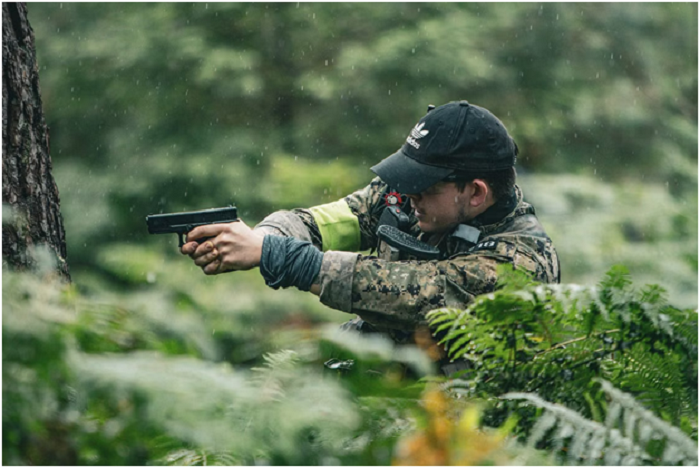
OCTOBER 21, 2026 – A military pistol can remain familiar long after the battlefield around it has changed. The Colt M1911, Beretta M9, and SIG Sauer M17 belong to different generations, yet each inherited the same assignment: serve as a sidearm when a primary weapon wasn’t available or practical.
The evolution of military pistols is therefore more than a succession of newer designs. It reflects changing expectations about ammunition, training, maintenance, and the soldiers carrying them. Across more than a century of U.S. service, arguments about the ideal semi-automatic pistol have shifted without entirely disappearing. Today’s emphasis on adaptable weapons gives that history fresh relevance, especially because each replacement reveals what the previous generation could no longer provide.
The Short Answer: Caliber, Capacity and Modularity
The Colt M1911 answered the Army’s demand for a larger-caliber, self-loading service pistol after combat experience undermined confidence in the .38 Long Colt. Adopted in 1911, its single-action, .45 ACP design established the baseline against which later replacements would be measured.
The Beretta M9 replaced it in 1985 because the military faced an aging pistol inventory and requirements extending beyond bullet diameter. NATO ammunition compatibility and a 15-round magazine favored the double-action, 9mm pistol over the seven-round M1911. The decision balanced ammunition commonality, controllability, and available rounds rather than treating stopping power as the only criterion.
In 2017, the Army selected SIG Sauer’s P320-based system as the M9’s successor. The striker-fired SIG Sauer M17 and compact M18 centered on a removable fire-control unit, allowing different grip modules, slides, and barrels within one family.
The progression runs from stopping power to standardization and capacity, then to adaptability. The sidearm’s backup role remained recognizable, but the military’s definition of an acceptable solution changed. That changing definition explains the progression better than any claim that the newest pistol simply made everything before it obsolete.
The M1911 and the Search for Stopping Power
John Moses Browning’s Colt M1911 won the Army’s pistol trials and entered service in 1911. Its short-recoil operating system paired the .45 ACP cartridge with a magazine-fed action, answering a demand shaped by earlier combat experience.
Why the Army Wanted a Bigger Bullet
Reports from fighting against Moro combatants in the Philippine-American War undermined confidence in the Colt Model 1892 and its .38 Long Colt cartridge. Accounts of attackers continuing after being hit pushed the Army toward a larger caliber, although those experiences didn’t establish a universal measure of “stopping power.”
The 1904 Thompson-LaGarde tests, conducted on cattle and human cadavers, recommended a military handgun caliber of at least .45. Their methods wouldn’t settle a modern terminal-performance debate, but their conclusion influenced the Army’s requirements.
The change therefore concerned both the cartridge and how the soldier’s sidearm operated.
From M1911 to M1911A1 Across Seven Decades
Demand during World War I exceeded M1911 production. Model 1917 revolvers from Colt and Smith & Wesson supplemented the pistol, using .45 ACP ammunition with moon clips that supported loading and extraction of the rimless cartridges.
The M1911A1 refinements of the 1920s addressed handling rather than replacing the underlying design. They included a shorter trigger, an arched mainspring housing, a longer grip-safety spur, and frame relief cuts behind the trigger.
The A1 served through World War II, Korea, and Vietnam. By 1985, the replacement question concerned not simply whether the design still worked, but also the condition of the military’s inventory.
Why the Beretta M9 Replaced the .45 in 1985
The Beretta M9, a military version of the Beretta 92F, became the standard U.S. service pistol after the replacement trials. It ended the M1911 family’s 74-year tenure as the standard sidearm, though not every unit surrendered its .45s.
Why 9mm Won Out Over the .45 ACP
NATO standardization gave the caliber change a logistical purpose: adopting 9mm let American units draw on the same 9mm ammunition stockpiles as allied forces, simplifying supply lines during joint operations. Ammunition compatibility mattered independently of arguments about individual cartridge performance.
The M9’s 15-round magazine offered more than twice the M1911’s seven-round magazine capacity. Lighter cartridges reduced ammunition weight, while the M9’s comparatively manageable recoil supported training across a broad population of shooters.
Critics still favored the .45 ACP’s larger bullet. That disagreement didn’t disappear with adoption, nor did capacity prove that one cartridge was universally superior.
Double-Action Design and the M9’s Later Variants
The M9 introduced a double-action first trigger pull, followed by lighter single-action pulls after cycling. Its slide-mounted decocker/safety allowed the hammer to be lowered without pulling the trigger, changing the handling routine from the M1911’s single-action arrangement.
Those controls didn’t eliminate the need for disciplined handling. Early slide failures also prompted a retention modification intended to prevent a separated slide from traveling rearward off the pistol.
Later developments addressed different needs. The Marine Corps’ M9A1 added an accessory rail, while the M9A3 offered further updates before the Army selected a replacement.
Meanwhile, MEU(SOC) units retained specialized .45 pistols, and Special Forces used nonstandard handguns. “Standard issue” never meant that every American service member carried an identical sidearm.
The SIG Sauer M17 and the Modular Handgun Era
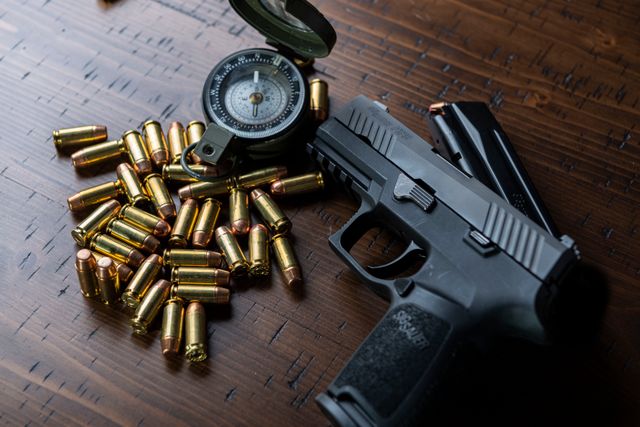
The SIG Sauer M17 shifted the replacement question again. Rather than choosing only a different cartridge or trigger system, the Army selected a pistol built around a removable fire-control unit. That architecture distinguished the new system from its predecessor.
What the Modular Handgun System Trials Demanded
In 2017, the Army selected SIG Sauer’s entry in the XM17 Modular Handgun System competition. The selection concerned a handgun system, not merely a replacement for worn M9s.
Modularity separates the internal fire-control assembly from the external grip module. Compatible components allow changes in fit or configuration while retaining the same core assembly. For military use, that creates options for fitting the weapon to different hands and assignments.
The selected pistols also brought striker-fired operation, ambidextrous controls, accessory rails, and provisions for optics. These features shouldn’t all be confused with mandatory trial requirements: striker-fired operation, in particular, describes the winning design rather than the only permissible action type.
How the Full-Size M17 and Compact M18 Differ
The M18 shares the M17’s operating system but uses a shorter slide and barrel. It isn’t simply a different name for the same external package, nor is it a wholly separate handgun design.
That distinction matters for issue and training. A shorter pistol occupies less space, while common mechanics preserve a shared operating approach. Both retain a manual safety, so the change from the M9 wasn’t a wholesale rejection of external safety controls.
The M18’s adoption across services, including the Marine Corps, also shows why the modern replacement story can’t focus on the full-size M17 alone. The system supports different configurations rather than expecting a single fixed-size pistol to answer every service requirement.
What a Century of Sidearms Tells Us
Each replacement answered a different institutional problem. The Colt M1911 reflected the Army’s demand for a larger-caliber self-loading pistol. The Beretta M9 put ammunition interoperability and magazine capacity alongside individual-shot performance. The SIG Sauer M17 made adaptability a central feature of the service pistol itself.
Across those changes, the pistol remained a backup weapon. What shifted was the definition of an acceptable solution: first the cartridge and action, then the ammunition supply and capacity, and finally the relationship between a common mechanism and different users.