The Lowe-Down on Audiobooks -
November 2007
Audiobooks Reviewed by Jonathan Lowe
Among
Garrison Keillor's gifts is creating--spontaneously--characters who
possess all the eccentricities inherent in Scandinavian immigrants
and depressed, old school Lutherans. His latest,
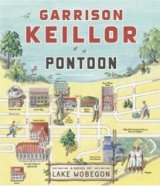
PONTOON, is a novel of just such inventions, born of rigorous
observation and a nostalgia for small town America. But you need a
framework for such rambling humor, so here the town of Lake Wobegon
is planning a wedding that includes a flying Elvis and a pontoon
boat (symbolic for newlyweds "about to take a journey.") To spice
up the proceedings, a delegation of "renegade Lutheran pastors" have
arrived from Denmark. and while one old biddy is preparing to die,
her daughter is more interested in having a dalliance at the Romero
Motel. The Mark Twain of Minnesota, Keillor also reads the novel,
which is more like a series of vignettes--wry, ironic, and full of
calculated surprise. His familiar voice drifts, sometimes wearily,
among all these shipwrecked souls like a pilot out of life
preservers. Still, there is empathy and identity here, rather than
pity, and so in his own way he points out that any victims among the
residents are floating in a pond, not an ocean. Chronicling their
innocent insanity with long practiced timing, Keillor ultimately
reveals how invisible we can be to each other--and to ourselves. (Highbridge
Audio; 8 hours unabridged)
Lorna Landvik
is author of a bestseller with the offbeat title "Angry Housewives
Eating Bon Bons." Her new novel THE VIEW FROM MOUNT JOY is not
quite as eccentric, but as read by the ideally matched Robertson
Dean, is more universal and therefore endearing. The story follows
Joe Anderson, a teen hockey player who grows up to be a town grocer,
while the girl he lusted for in high school moves on to become rich
and famous. Joe has settled down and settled in, yet he still
yearns for what might have been with the seductive Kristi Casey. . .
until Kristi returns to town one day, and Joe realizes that his own
life is the more meaningful. It's an old story with a modern
retelling, and yet somehow, either by chance (or by what I hope is
deliberate choice), the teller of the tale has been picked for his
ability to elevate and enliven the text with his unusually sensitive
yet self-assured delivery. (Random House Audio; 5 hours abridged)
Next, Dick
Francis is up for yet another horse racing linked mystery titled
DEAD HEAT, about a restauranteur named Max Moreton, whose latest
catering job goes awry when undercooked kidney beans cause illness,
and threaten his next job--an exclusive luncheon for guests at a
high stakes horse race. When that race is terrorized by a bombing,
Max's complications multiply, and lead to an investigation involving
the transport of drugs inside the wombs of mares. The story moves
slowly, as most "cosy" English mysteries do, but the benefit of
moving slowly is that one has time to notice the scenery. Helping
with that is narrator Martin Jarvis, whose inimitable poise and
inflection give the tale a stately and refined aura. Jarvis is not
only a character actor in Hollywood, after all, but is also invested
with the Order of the British Empire for his services to drama.
(Penguin Audio; 10 hours unabridged)
Can anyone
fault DUNE, one of the most beloved classics of science fiction?
True, there have been other performances than the current 2007
release from Audio Renaissance. Imitators of the original story
have been many as well--both in film and on TV. So is there
anything to criticize in this latest production, whose audio values
include the talents of narrators Simon Vance, Scott Brick, Euan
Morton and Orlagh Cassidy, among others? Not really. Although I
still puzzle on Frank Herbert's choice of the names "Paul" and
"Jessica" and "Duncan," and his borrowing of Shakespearean
entanglements and ambience. Yet if you're going to borrow from
anyone for a epic story, who better than the Immortal Bard of Avon?
Certainly Star Wars borrowed from Dune, as its more modern
influence. As you may know, the continuing saga of Dune neither
starts nor ends with Paul Atreides as the Muad'Dib duke who commands
the sand worms of Arrakis, and although the star of the movie
version is now acting on "Desperate Housewives," the award winning
original novel--if not the entire series on audio--will outlive any
shallow television series. As true literature usually does. (Audio
Renaissance; 22 hours unabridged)
Finally, C. J.
Box has penned an unusual mystery in FREE FIRE, about a lawyer who
kills four environmental activists in Yellowstone National Park,
then walks away on a technicality involving a slice of land where
the murders occurred--a "free fire zone" of overlapping
jurisdictions, where a jury cannot be found since no one lives
there. When public outcry begins to burn his ears, the governor
hires former game warden Joe Pickett to investigate, and the
solution to the how and why of the crime involves investigating
Yellowstone itself. Narrator here is actor David Chandler, whose
straightforward approach rings true as a documentary-like unfolding
of the story. At times you feel like John Wayne is narrating,
without the accent. Luckily, the tale is not unbefitting for John
Wayne, so a reader the likes of Richard Ferrone isn't required.
(Recorded Books; 10 3/4 hours unabridged)
(These audiobooks may be rented from
AudioAdventures.com.)
The Lowe-Down on Audiobooks -
October 2007
Audiobooks Reviewed by Jonathan Lowe
On the day before
Halloween, 1938, millions of Americans tuned in to a popular radio
drama program hosted by Orson Welles. Unfortunately for listeners
that day, Welles' adaptation of "The
War of the Worlds" presented the radio drama as if it were an
actual news broadcast. Fake updates described a "huge flaming
object" dropping from the sky near Grovers Mill, New Jersey. Actors
read lines like "Good heavens, something's wriggling out of the
shadow like a gray snake. They look like tentacles to me!"
While the beginning of the broadcast indicated its fictional nature,
the explanation wasn't repeated until more than half an hour later.
In the meantime, the panic that ensued soon made legitimate news
headlines, with stories of people hiding in cellars with loaded
guns, or wrapping their heads in wet towels for protection from
Martian poison gas. It all prompted New York Tribune columnist
Dorothy Thompson to declare that, "All unwittingly, Mr. Orson Welles
and the Mercury Theater of the Air have made one of the most
fascinating and important demonstrations of all time. They have
proved that a few effective voices, accompanied by sound effects,
can convince masses of people of a totally unreasonable, completely
fantastic proposition."
This was the Golden Age of Radio, which didn't fade until the newer
technology of television took over in the 1950s. Oddly, the
effectiveness of radio wasn't diminished even by World War II, since
news broadcasts spurred a need for escapist evening drama,
particularly thriller drama. During a typical wartime season, then,
radio networks offered 25 programmed hours each week of shows like
"Suspense" and "The Shadow." Even later, when television was young,
many successful radio series were adapted for the small screen, like
"Gunsmoke," which could then be heard on radio and seen on TV
simultaneously. In fact, only when the number of TV sets began to
near the number of radio sets in American homes did the medium die
as a popular addiction.
But has it died
completely? For a look at those the state of radio and audio drama
production today, I interviewed Sue Zizza, Executive Director of
what has become the National Audio Theatre Festivals. Zizza also
teaches a course on the subject of audio drama at New York
University.
"Back in 1979," Zizza recalled, "when I was on staff at a community
radio station in Missouri, we put feelers out across the country to
other dramatists in the field. The intent was to see who was still
doing what, and to form a new group of professionals, utilizing
funds provided at the time by public radio, the NEA and CPB. The
suggestion was made to form a training event, the Midwest Radio
Drama Workshop was born. Now, our week long workshops in Missouri
introduce people at all skill levels to audio drama production." As
Zizza further explains it, "We believe that if you learn how to
produce an audio play, where you're blending voice and music and
sound effects and silence, then you can take those skills and become
a better documentary, film or music producer, because what you learn
through telling your story as audio drama really hones your
storytelling craft."
In addition to week long workshops, the NATF also sponsors weekend
events around the country, focused on one particular skill, and at
the end an actual performance is staged so that these learned skills
can be practiced. "Take Lindsay Ellison, for example," Zizza points
out, "who added audio production and direction to her stage
direction and acting skills. Now she's working with Tom Lopez on
the post production of her play. Others take classes in voice
acting, writing, producing, directing and technology. After
learning the fundamentals, they mount a live show as an effects
artist or technical assistant."
In describing the unique challenges of audio drama, Zizza cites
knowing how to make voices unique “because obviously there are no
body types or hair colors as in stage acting.” Also, knowing when
and how often to utilize sound effects is important, “because too
much sound design only confuses the listener, and should only be
used to support the action, identify locales, or move characters
around a space.” In short, the listener must be clear at all
moments about what is going on. And that rule has never changed.
But hasn’t the equipment changed since radio's Golden Age? "Not
really," claims Zizza. "Many of the props I use today were
inherited from my mentor Al Shaffer, who did sound effects for Bob &
Ray, among others. He taught me how to do horses, walk down stairs,
etc. The only thing that's really changed is that the microphones
are more sensitive now, so you can't get away with using an old-time
prop like cellophane to make fire. Although corn starch is still
used for walking through snow." She's adamant that sound effects
taken from CDs don't work for the most part, even in our modern,
high-tech era. "The acoustic space is not the same as the space
where the actors record, and you can tell. With animals in a zoo,
for example, there's a reverb which can't be corrected. So getting
a sound effects artist to listen and add effects in real time
actually saves time. Where the science has advanced is really in
post production, with digital recording and editing. But if you
don't understand how the elements of writing and acting and sound
design combine in the final product, it won't matter if you're
producing it digitally, and Pro Tools won't save you."
Zizza says that part of her funding today comes from the National
Endowment for the Arts, and part from the local arts councils where
the festivals are held, and from individual contributors. The audio
drama community as it exists today consists of "about two hundred
independent companies or individuals producing mostly new material,
although maybe half will produce both old time and new scripts."
For her own part, she produces The Radio Works, a sampler series
which is heard on 70 public radio stations, and features a different
producer each time, with all new work. Other audio drama companies
currently active include the Full Cast Audio company, the Atlanta
Radio Theater, Great Northern Audio Theatre, ZBS Foundation,
Firesign Theatre, Shoestring Radio Theater, and the Radio Repertory
Company of America. Seeing Ear Theatre, associated with the Scifi
channel, produces original plays for publishers like Harper Audio,
like the excellent "Two Plays for Voices," featuring actors Bebe
Neuwirth and Brian Dennehy performing Neil Gaiman's "Snow Glass
Apples" and "Murder Mysteries." And of course L.A. Theatre Works,
perhaps the most highly regarded audio theatre company, employs
talented professionals like Richard Dreyfuss and Marsha Mason to
record classic plays as audio dramas for distribution in bookstores,
like Neil Simon's "The Prisoner of Second Avenue."
What does the future hold? Zizza is cautious, but optimistic.
"Full cast audio is costly to produce, and so there are not as many
titles available. This is also true for public radio stations, who
find it more economical to produce news or talk shows. But I think
the situation is improving over what it was just three years
ago. With all the webcasting and iPod downloading going on, I think
people will seek out audio drama, and already a new crop of
directors and producers are studying the craft the same way as those
who study stage acting. Our challenge is to produce better quality
material, and take those interested to the next level of skills so
that audio theater looks forward instead of backward."
For a befitting sampling of full cast stories this month, give a
listen to A GROWN-UP'S HALLOWEEN, directed by radio drama pioneer
Yuri Rasovsky for Blackstone Audio. "Dedicated to the thinking
paranoiac," the collection includes stories by Kafka, Dostoevsky,
Bierce, Twain, Shaw, and "A. Fiend." (Probably Yuri himself).
Eclectic and unusual, the audiobook was nominated for an Audie in
2007. http://www.blackstoneaudio.com/audiobook.cfm?ID=4096
Having directed my own audiobook "Fame Island," Yuri also directs
and reads a just-released collection of horror stories by Richard
Matheson titled I AM LEGEND, with narrator Robertson Dean. The
title story is about a man who might be the last human in a world of
vampires, and his survival amid the ruins of what we imagine to be
"civilization" is chilling, and also ironic--even comic--as
Rasovsky's choices usually are.
(These audiobooks may be rented from AudioAdventures.com)
The Lowe-Down on Audiobooks -
September 2007
Audiobooks Reviewed by Jonathan Lowe
The mechanics of science rarely invade the media of mass culture, and
the reason is obvious. Ignorant of little more than sound bites and
so called "reality" shows, the typical American consumer is not only
near-sighted, but insular. While he may own a cell phone, a WiFi
accessible computer, a plasma TV and an iPod, he doesn't really
understand how they work--or care. To interest such a person, one
must be both entertaining and provocative, which is just what
astrophysicist Neil DeGrasse Tyson does in
DEATH BY BLACK HOLE, a
collection of carefully arranged essays written for Natural History
magazine. Read by actor Dion Graham, the book is a patient,
simplified cosmic guide that puts in perspective what is knowable
about the biggest questions of all--where we come from, are we alone
in the universe, and does religion fit in. While it can't answer
these questions, it does reveal their depth, dispelling widely held
myths. The title refers to what may be the most bizarre way to die,
(and one which CSI will never be able to investigate.) Seen on the
PBS program NOVA, and possessing innate communications skills
himself, Tyson could have narrated this audiobook version, had he
time. But what exactly is time, or gravity? And why can't he--or
anyone--move faster than the speed of light? Tyson patiently
explains, wielding the voice of an equally entertaining professional
reader, who seems to have grasped the essence of Tyson's persona. In
the process, the listener begins to imagine the Earth as a grain of
sand on the cosmic beach. So much for thinking celebrity awards
shows are all that important! True to ironic form, the production is
also available in Mp3 format for direct download to the now
astronomical number of iPods out there. (Blackstone Audio; 12 hours
unabridged)
Moving from science to science fiction, there's the intriguing
EIFELHEIM, from the award winning Michael Flynn. It's about a
historian and his theoretical physicist girlfriend, who investigate
the history of a German town that mysteriously disappeared in 1349.
At first they think it had something to do with the Black Death,
which was infecting Europe at the time. But due to the multiple
viewpoints the listener knows that it was the site of first contact
with aliens, where a spaceship "crashed" in the nearby forest.
Although "crash" is not the right word, as the ship travelled through
from another dimension or alternate universe. Moving between the
past and present, the story is narrated by Anthony Heald, best known
for playing Hannibal Lecter's jail nemesis in "The Silence of the
Lambs." It's also the best thing about the audiobook, since Heald is
an incredible actor, with a quirky delivery that's particularly
chilling in his subdued voice portrayal of several of the aliens.
(Blackstone Audio; 17 hours unabrided)
Next, can you force someone to love you? Yes, according to author
Nicholas Boothman in HOW TO MAKE SOMEONE LOVE YOU FOREVER.
Ostensibly, such a task takes time, since you can't hurry love.
Hence, the subtitle here is "In 90 Minutes or Less," which is longer
than Boothman took last time out, when he penned "How to Make People
Like You in 90 Seconds or Less." Actually, the book takes a while to
listen to, and the author suits the narration, being a former fashion
photographer and ad man, now a non-verbal communications guru. In an
age when looks matter most, he schools listeners on how to dress, how
to act, and what to say. . . whether you want to be a Stepford wife
or not. While much of what's discussed seems obvious, the most
intriguing aspects are those we may overlook, as the author points
out our subconscious defensive postures, which take conscious effort
to overcome. Because just being yourself may not get you love,
unfortunately, if don't know how to hide your insecurities or a
suspicious nature. (Listen & Live Audio; 4 hours abridged)
Two more new books are also out, both of which reveal our changing
culture, and both of their authors went to Yale. First is SUPER
CRUNCHERS, by "econometrician" and lawyer Ian Ayres, about
statistical analysis in the new America. While you may have long
suspected you were only a "number in the system," here's proof that
you really are. Because not only are your demographics being
analyzed by advertisers, but your individual history of purchases is
being melded with reams of other data regarding how likely you are to
respond to sales pitches, charity drives, or direct mail and magazine
ads. All that information is crunched inside silicon chips before
you're ever targeted. If they know your age, your income, and where
you live, all they need is to trace your buying habits, and they'll
also know how you'll vote, what you'll likely to want next, and what
percentage rate you're apt to accept on a credit card--information
that's fully displayed on the computer screen of that company rep you
have on the phone. Sound scary? Welcome to the new information age,
where having an original thought is about as rare as an angel in the
infield. . .or minefield. Actor James Lurie narrates, lending his
controlled vocal skills to any defects in Ayres' own voice, making
this a engrossing account of the strange-but-true, like an episode of
the TV show "Numbers." Ayres even claims he arrived at the title by
analyzing the number of hits on a proposed website. Now if only
someone would crunch the numbers on Iraq, we'd finally demand term
limits before our economy collapses. (Random House Audio; 6 hours
abridged)
Finally, there is FLAWLESS, a medical thriller by Stanford med
student and Yale grad Joshua Spanogle, about a former CDC detective
who can't leave the profession because an old friend has been
murdered, and he's needed to investigate the dead man's medical
research papers involving a dangerous cosmetic drug. What makes the
story interesting is not so much the writing or plotting, which can
be simplistic or clichéd, but rather the learning process of the
protagonist, and the subject matter. Given that we're all numbers,
now, it follows that the more perfect your numbers, the more
desirable and "worthy" of love. One's "figure" should be flawless,
while the number of tiny lines and wrinkles should be few. Be
willing to pay any price for this, Spanogle seems to be saying, and
that price may be larger than the number pi. Scott Brick narrates,
and is always a pleasure to listen to, forever breathing life into a
host of characters, flawed or otherwise. (Random House Audio; 6.5
hours abridged)
(These audiobooks may be rented from AudioAdventures.com)
The Lowe-Down on Audiobooks -
August 2007
Audiobooks Reviewed by Jonathan Lowe
Whether novel or novella, English author Ian McEwan's latest,
ON CHESIL BEACH, is an emotional exploration of the disparate
experiences of two young people--and the evolution of one--centering
on their lack of experience in matters of sex. The couple in the
white hot spotlight are Edward Mayhew and Florence Ponting, who marry
in their twenties in 1962, then attempt to consummate their love in a
honeymoon suite on the Dorset Coast. Edward is a history student
with a growing love of rock music, while Florence loves classical
music, as the daughter of an Oxford philosophy professor. If she is
serious and sensitive, he is impatient and naively expectant. So
when their painfully embarrassing first union fails on all levels,
she runs out onto the beach to be alone, and--unfortunately--he
follows. Because when accusations are traded, they part. This
forces Edward to push past the unspeakable to the ultimate question
that later haunts him: had he given her space, might time have
healed their pain, and mended their relationship for a second
chance? Since "there was no language to say what needed to be said,"
Edward goes on alone, later wondering what might have been, had he
possessed patience as well as love. A wistful yet profound book, ON
CHESIL BEACH is all the more attractive in its audio version, since
the author himself dramatizes the book's fears and emotions as its
capable narrator. Able to be listened to in one sitting, the
audiobook also includes a surprising interview with McEwan at the
end, and what's best about this is that Ian's interviewer doesn't ask
him how he works, but rather engages him in a probing discussion of
how universally frightening real intimacy can be, even today. In
this way, we learn more about the author than had the questions been
limited to writing habits, book deals, and other celebrity trivia.
Which is exactly the point of McEwan's writing--to get under the
surface to the truth, however uncomfortable the act may be. (Random
House Audio; 4 hours unabridged)
In BANGKOK HAUNTS, author John Burdett explores the more heartless
and empty world of pornography and corruption in Thailand, as his
Royal Thai detective Sonchai Jitpleecheep investigates the murder of
a woman he once loved. His girlfriend Damrong was killed in a snuff
film made available for sale, which naturally motivates him to enter
the dangerous, exotic world of street gangs and shady men's clubs to
expose those who profit from other people's misery. The pervasive
acceptance of exploitation is most disturbing for Sonchai as his own
boss becomes involved, to boot. As read by Glen McCready, Burdett's
novel succeeds in illuminating how Bangkok became a tourist
destination for perverts, too, although in real life there have been
laws implemented in recent years to discourage the practice. Given
the societal commentary such a plot undertakes, it's superior to
simple serial killer plots set in America, although perhaps our lone,
home-grown killers also say something about the estrangement of our
own violent, competition-obsessed society as well. (Recorded Books;
12 3/4 hours unabridged)
Clive Cussler's thirty-fourth book, THE NAVIGATOR, is his seventh
collaboration with Paul Kemprecos, and again utilizes the National
Underwater & Marine Agency's "Special Assignments Team." When an
ancient Phoenician statue was stolen from a Baghdad museum in 900
BCE, the secret it carried from the past reach into the future of the
present day to inspire murderous lust. Victims of the men seeking
the statue soon include a crooked antiques dealer, and--very nearly--
a UN investigator. With ties to the lost treasure of King Solomon,
plus documents encoded by president Thomas Jefferson, the mystery
follows a well-worn formula of surprise, deceit, action and
intrigue. Narrator here is actor Richard Ferrone, whose gravelly
voice is well known in mystery productions, primarily for Recorded
Books, and he acquits his duties well. As for the writing, it is not
without cliches and some painfully overwrought metaphors, but fans
will forgive almost any transgressions to keep both the Kurt Austin
and the Dirk Pitt series from ending. (Penguin Audio; 6 hours abridged)
According to author Travis Bradberry in THE PERSONALITY CODE, there
just fourteen fundamental personality types. His research is based
on a global study of half a million people, showing that these
fourteen types result from an intermingling of only four major
traits--Dominant, Interpersonal, Steady, and Conscientious. Knowing
which type you are, and how your type typically interacts with other
types, can supposedly help you decipher your reactions to other
people, and their reactions to you. You find out which type you are
by taking an online test, using the code supplied inside the cover of
the audiobook. Sound too easy to be true? I took the test, which
calculated my type as "Architect." Looking at descriptions of the
fourteen, I could see that it was mostly true, although I probably
wouldn't have guessed it for myself. Perhaps this means I don't know
myself as much as I should? That's certainly the book's major
claim: that self awareness is the key to success in all areas of
life, and that few people truly know who they are. Since types
change little over a lifetime, I'm also told I now have a tool to
understand conflict, within and without. Narrated by Lloyd James, it
all sounds convincing, even if the waters seem, at times, a bit
muddy. (Tantor Media; 4 hours unabridged)
Finally, narrators are obviously story tellers, but there are other
professional story tellers whose stories have more to do with fables
and anecdotes than actual books. Joel ben Izzy is one such person,
and his own true story is told in THE BEGGAR KING AND THE SECRET OF
HAPPINESS, which is about the loss of his voice, and how it changed
his perspective and led him to an understanding of happiness and true
success. Along the way, Izzy uses the timeless wisdom of ancient
tales to illustrate his points. Beggars, kings, monks, tigers,
buried treasures--they all serve as fuel to warm the heart of this
small but powerful volume, which is essentially about unexpected
truth. The book is narrated by the author, whose gentle and
sensitive reading make it an excellent gift for Christmas or
Birthdays. (Highbridge Audio; 4 1/2 hours unabridged)
(These audiobooks may be rented at Audio Adventures by calling
1-800-551-6692, or by visiting AudioAdventures.com.)
The Lowe-Down on Audiobooks -
July 2007
Audiobooks Reviewed by Jonathan Lowe
In the classic SF story "A Boy and His Dog" author Harlan Ellison
postulated a post apocalyptic world in which a young man wanders
through a devastated urban landscape with an intelligent dog. The
story was an award winner, made into a less than successful film. On
the same theme, now, comes
THE ROAD by Cormac McCarthy, who is past
winner of the National Book Award, and here garners more adulation
than any of his previous books. The plot is threadbare, as not much
happens to "the man" and "the boy," as they are called. Not only
don't we really know who these characters are, but we don't know what
has happened to them, or where they are going. Perhaps it's nuclear
winter, because the world is definitely dying. On the road to the
sea in futile hope of survival, they move through a blasted landscape
where not even birds fly anymore. In fact, their relationship is all
they have left, other than some blankets and a shopping cart. By
focusing on this relationship, though, and by making these two
characters representative of us all, McCarthy saves the story from
collapse with allegory, revealing that the universal will to survive
can ennoble the human heart, which needs love and hope even in the
face of annihilation. Narrator Tom Stechschulte is a rare breed of
actor whose ability to seamlessly simulate reality is unsurpassed.
Disappearing behind the text, Stechschulte adds authenticity with a
natural rhythm and empathetic tone. (Recorded Books; 6 3/4 hours
unabridged)
In PLAY DEAD by David Rosenfelt a rich lawyer named Andy Carpenter
didn't get rich by practicing law, but rather by winning the lotto.
So he doesn't need to pay his bills with high profile corporate
cases. Since he has an affection for golden retrievers, when he
finds one in danger he's on the case. The dog shouldn't be alive,
because it had to swim so far to shore, and yet there it is, at the
pound, awaiting doggie "execution." Soon the dog is key witness in a
crime, but can the judge take canine testimony seriously?
Essentially a murder trial story, the novel is also unusual for its
witty self deprecation, and is penned by the author of an even more
amusing tale, "Bury the Lead." Narrator Grover Gardner is the ideal
voice to interpret these offbeat characters, with a pitch perfect
rendition that's eccentric and rough around the edges when it needs
to be, and most pleasant, rich, and intriguing when it doesn't.
(Listen & Live Audio; 8 hours unabridged)
What is the true secret of happiness? Can it be achieved by being a
rat racer, scurrying to gather as many nuts as possible? Quite
simply, no, according to Tal Ben-Shahar, author of HAPPIER, and the
lecturer behind Harvard University's most popular course, "How to Be
Happy." Being happy is more about psychology than achievement, so
you don't need a big job promotion, a new love life, or even a book
telling you how to change your luck. Being happy is about being
alive in the present, not just living for the future. So a more
important currency than money is the currency of joy, earned through
friendship, honesty, trust, experience, and some simple exercises
that the author outlines with the help of straightforward and helpful
reader Jeff Woodman. Simple enough, but only if one manages to dodge
the brainwashing of a mass media urgently selling substitutions for
happiness in the form of mass marketed consumer products.
(Highbridge Audio; 4 1/2 hours abridged)
Cambridge professor Rebecca Stott's debut novel is GHOSTWALK, about
the mysterious drowning death of a Cambridge University scholar right
before the completion of her biography of Isaac Newton. The dead
woman's son recruits his former lover to complete the controversial
book, which results in the investigation of two separate murders
sprees. The point of view moves between 17th century Cambridge,
where Newton was hindered in his studies, to present day Cambridge,
where an animal rights group is involved. Lydia Brooke's work is
guided by a ghost from Newton's time, who advises her that the role
of Newton's alchemy involved supernatural forces. To this day it's a
mystery what Newton was really up to with his dabbling in alchemy,
and Stott offers up her own postulation here, in this entertaining
and descriptive debut. Reader Susan Duerden can be cited for
maintaining interest throughout the romantic cross genre mystery with
an engaging yet sensitive performance that presumes more than just
acquaintance with both the characters participating and the audience
listening. (Random House Audio; 6 hours abridged)
Finally, SF writer Philip K. Dick was known for his short stories,
primarily. A surprising number of them have become the inspiration
for movies, like "Blade Runner," "Total Recall," and "Minority
Report. " In MARTIAN TIME SLIP and THE GOLDEN MAN, two novellas on
the theme of what it means to be human are narrated by Grover
Gardner. In the first, a mentally "ill" boy just might hold the key
to the future, and a real estate scam on Mars serves as a means to
reveal the truth, along with a murder. The second tale inspired the
recent movie "Next," and employs the cliché so often used by comic
book writers, postulating a post-holocaust America populated by
mutants. Dick elevates the story by introducing one of the mutants
as a mute yet perfect young man, whose very perfection (rather than
his hideous deformities) make him a target for destruction by
government agencies. The irony is that this so-called "mutant" may
actually be the next step in evolution for mankind, superior in
strength and beauty, but more importantly devoid of the egotistical
passions we currently possess, or the fears that inspire envy and
revenge. Gardner narrated the first story almost ten years ago, and
the second this year, adding to his total career number of over 550
titles narrated. (Blackstone Audio; 9 1/2 hours unabridged)
(These audiobooks may be rented at Audio Adventures by calling
1-800-551-6692, or by visiting AudioAdventures.com)
 Audiobooks